Showing posts with label Exploration. Show all posts

Friday, November 9, 2007

Inida: Government Tightens Rules for Exploration


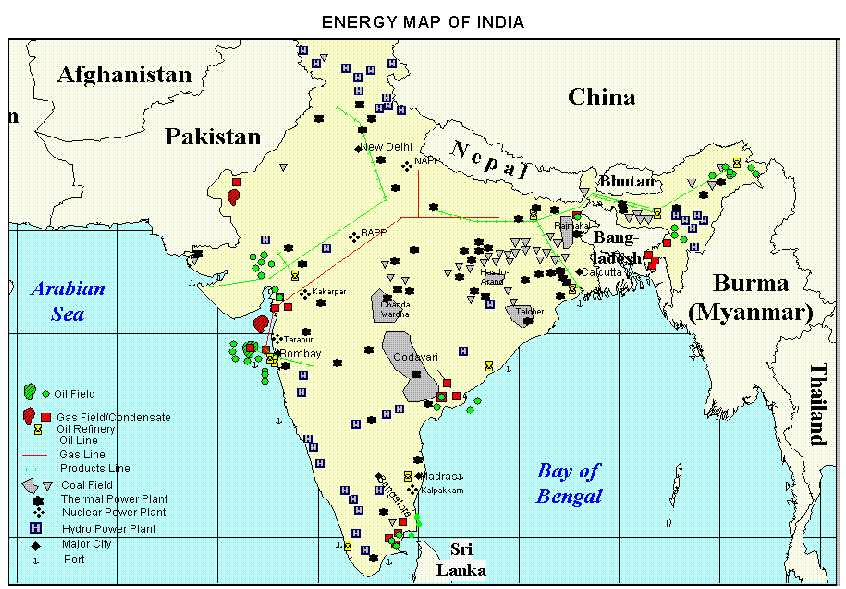
A recent article came across Rigzone about the "Indian Government Tightens Rules for Oil & Gas Exploration"


This is interesting, as recently in Alberta, they recently had a royalty review. Russia has been taking more control of their resources, along with Venezuela, etc.


Essentially the major changes are occuring to the PSA (Production Sharing Agreements).


The main changes are:


  • "Until such time as the availability of natural gas from all petroleum production activities in India meets the total national demand as determined by the government, each company comprising the contractor, shall sell in the domestic market in India all of the company's entitlement to natural gas from the contract area."

Cutting to the chase, the natural gas now has to be sold domestically, rather than exported, as it currently is being done.


Further the Indian government states in the release:


  • "If India attains self-sufficiency, during any year, the government shall advise the companies accordingly by a written notice. In such an event, domestic sale obligations shall be suspended for such period as may be specified by the government, and the company shall have the right to lift and export its participating interest share of natural gas during the said period, subject to any extant policy guidelines of the government, applicable from time to time."

So once, India, has enough natural gas production to become self-sufficient, any excess can be exported, subject to any policies at the time of the government in power at the time.


So is exploration going to slow down because of this?


I do not feel so, as any natural gas producers now have a natural (bad pun!) market for the gas - India.


It also encourages exploration companies to build up and explore for natural gas, as the more they find, the easier they can satisfy a domestic market and then any excess can be exported.


Friday, November 2, 2007

Mozambique: Exploration is under way!


Mozambique is often not a country that one associates with oil and gas exploration.


This country in southeastern Africa is bordered by the Indian Ocean to the east, Tanzania to the north, Malawi and Zambia to the northwest, Zimbabwe to the west and Swaziland and South Africa to the southwest.


Quoting from the INP, we can get a good history of oil and gas exploration here:


"Exploration for hydrocarbons in Mozambique goes back to 1904 when the early explorers discovered thick sedimentary basins onshore Mozambique. Poor technology and lack of funds halted those early exploration attempts.


From 1948 onwards international oil companies moved into Mozambique and carried out extensive exploration, mainly onshore with limited activity offshore. As a result the Pande Gas Field was discovered in 1961 by Gulf Oil followed by the gas discoveries of Búzi (1962) and Temane (1967). Exploration activity declined in the early 1970’s due to political unrest.


New activity was established in the early 1980’s with the enactment of law 3/81 and creation of ENH. In the following years extensive work was carried out to map and appraise the Pande Field. A breakthrough was made in 1993 when it became clear that the Pande Field could be mapped using direct hydrocarbon indicators (DHI) from seismic data and it turned out that there was a giant bright spot at the top of the reservoir. The method was later also used to map the Temane field with good result.


From 1970 to 1980 there have only been drilled 6 wildcat wells in Mozambique – 3 of them offshore. An extensive drilling campaign conducted by Sasol in 2003 which included exploration and production wells in the Pande/Temane Block allowed the expansion of gas reserves and the discovery of Inhassoro Gas Field, making total of 5.504 trillion cubic feet (TCF)."


In total, there have been 97 wells drilled in Mozambique. Breaking the numbers down further we see the following:


  • 61 wildcats

  • 24 appraisals

  • 12 production


They were located in the following regions of Mozambique:


  • 15 wells were located offshore

  • 16 wells over the Pande Gas Field

  • 18 wells in the Temane Gas Field

  • 6 wells in the Inhassoro Gas Field

  • 4 wells located offshore Zambezi Delta

  • 1 well in the Rovuma Basin


At the Africa Upstream Conference in Cape Town (Nov 2nd), INP announced (INP press release) the dates for the 3rd Mozambique Licensing Round which will include both onshore and offshore blocks (3rd License Round Map).


Currently, companies such as Petronas, StatoilHydro, Anadarko and ENI are working offshore Mozambique.


Why are companies looking to come to Africa to explore?


In 2001, Mozambique enacted, similar to Columbia, a regime that encourages exploration.


The details are as follows:


There are three kinds of concession contracts, and they are:


  1. Reconnaissance Contract: Maximum two years exclusivity.

  2. Exploration and Production Contract: Exploration period maximum 8 years. Production period maximum 30 years.

  3. Pipeline contract: Period depends on the project.


A tax and royalty regime that is competitive with other nations.


The Corporate Income Tax rate is 32% of net profit, with no ring fencing. Development costs are depreciated over four years.


The Law sets the royalty at 2 % to 15 %; normally rates are 3-7 % for crude oil, 2-4% for natural gas depending on water depth.


Onshore: 8% for crude oil and 5 % for natural gas.


And the legislated Code of Fiscal Benefits provides various investment incentives for the petroleum sector, such as exemption from import fees and VAT (petroleum).


As we can see the majors have entered and there is plenty of potential in Mozambique for companies willing to enter the country. Mozambique is stable and is not heard of often in the news - which is good.


Will Mozambique become the next Angola or Nigeria?


Time will tell.


Thursday, October 18, 2007

Lining up for Exploration: NOC's and IOC's

Some interesting news came across the Dow Jones Newswire and can be found on Rigzone about some offshore blocks off of Columbia.

The Libyan's are also have bidders line up for some blocks as well. The MMS just recently completed some bids for blocks over the past few months for the Gulf of Mexico (GOM).


As more and more National Oil Companies (NOC's) move further away from their homelands, they are treading into the waters of the Independent Oil Companies (IOC's) and gradually reshaping the way oil is being found.


New partnerships are being formed and as we are seeing what is being done in Venezuela and Russia (the nationalization of resource companies), these NOC's are now being seen as new powerhouses.

In the past, Norsk Hydro (or Hydro) of Norway, was one of the few NOC's that explored abroad, outside their own boundaries. Even in the Gulf States, Dubai, for example, has recently purchased some heavy oil land and companies in Canada.

So how does that affect us? National Oil Companies do not strictly operate on market principles alone. Because of their close relationship to their respective government, they may have other objectives, such as wealth distribution (Venezuela - PDVSA), job creation, economic development, and energy security. Whereas the IOC's are concerned with market values and returning a good share price for their investors.

Two different motivations.

In 2006, five of the top ten companies could be considered state-owned and operated. That seems to be a decent ratio of private to state - 50%.

An interesting paper was published by the Federation of American Scientists concerning this very topic.

Looking at it another way, based on reserves in 2006, the top ten producing companies would all be state-owned and includes the following:


  1. Saudi Aramco
  2. NIOC
  3. INOC
  4. KPC
  5. PDVSA
  6. Adnoc
  7. Libya NOC
  8. NNPC
  9. Lukoil
  10. QP

As with every company involved in E&P, their ability to be profitable for either their shareholders or the state-motivations, depends greatly on technology and where they are exploring.

In the article on Rigzone concerning the exploration bids for Offshore Columbia Blocks, one notices that several of the companies involved are state-owned and now working with the major independent's, such as BP.

By working with the independent for-profit companies and through production sharing-agreements (PSA's), it allows the state-owned oil companies to access new technology.

It will be interesting to see how the next few years plays out and the courtship between NOC's and IOC's continues.

Kenya: Lundin Petroleum building on the Anza Basin


When people think of Africa and oil and gas, they most often think of the oil producing nations of Angola and Nigeria, along with the gas producers of Algeria and Tunisia. East Africa is not often thought about as a producer.

Kenya’s Petroleum potential is best depicted by the four large sized sedimentary basins that straddle the Country (I've attached maps from the National Oil Company of Kenya - NOCK). The four basins are the Lamu, Anza, Mandera, and Tertiary Rift basins.

On October 4th, 2007, in Nairobi, Lundin Kenya B.V., a wholly owned subsidiary of Lundin Petroleum, signed a PSC (Production Sharing Contract) with the Honourable Minister of Energy of the Republic of Kenya. Block 10A covers an area of 14,748 square kilometers and is located in the onshore Anza Basin, an extension of the prolific Muglad Basin of Sudan.

From the NOCK website: "The Anza Basin is one in a series of Cretaceous-Tertiary failed rifts that trend across the Central African Craton from the Benue trough in Nigeria through Chad and the Central African Republic, the Sudan and Kenya. The right lateral movement on the Central Africa rift system is interpreted to have translated to Northeast-Southwest extension in Sudan and Kenya beginning by Barremian-Neocomian (Lower Cretaceous) time, resulting in basins with an overall northwest - southeast trend that is nearly perpendicular to the shear zone. Rifting continued into the Tertiary. Muglad, Melut and Blue Nile Basins of Sudan strike in the same direction as the Anza Basin. The Anza Basin is thought to correlate with the Mugland Rift Basin of South Sudan where profilic oil discoveries have been made The Anza Basin extends towards Lake Turkana and is separated from Mandera and Lamu Basins by the NW-SE trending Lagh Bogal fault and ENE-WSW trending Garissa-Walmerer basement high inferred fault respectively. The total surface area of the Anza Basin is about 94, 220 sq. km. The deepest well drilled in this basin to date reached a total depth of 4,392m."


In many cases, it is the small or mid-size independent oil and gas companies that do the major exploration, only to be gobbled up (thinking of Canadian Thanksgiving and turkeys!) by the Majors who are looking at bringing on proven reserves, without having to do all the hard exploration work. First Calgary Petroleum in Calgary is another small company that is working exclusively in Algeria. The logistics of working in Africa or any area where there is a lack of infrastructure (roads, pipelines, etc.) makes these challenging, yet exciting ventures to be involved in if one is fortunate enough.

Often in oil and gas, we only see the Majors (the ExxonMobils, Total, BP, Eni, etc.) and we tend to forget about the small companies that forge the way, through exploration and aquisition.

The good news is that exploration is continuing and there are opportunities out there for small and large companies to participate in this. Lundin and First Calgary are showing that Africa is not the great unknown and by willing to go into countries and take a chance, there may be successes. There may also be failures, but that comes with the business of exploration

Look out for these juniors!